| 【英語タイトル】Electric And Autonomous Vehicles Wiring Harness Market Size & Share Analysis - Growth Trends & Forecasts (2025 - 2030)
|
 | ・商品コード:MOR834LM79993
・発行会社(調査会社):Mordor Intelligence
・発行日:2025年2月
・ページ数:約100
・レポート言語:英語
・レポート形式:PDF
・納品方法:Eメール(受注後2-3営業日)
・調査対象地域:グローバル
・産業分野:自動車
|
◆販売価格オプション
(消費税別)
※販売価格オプションの説明
※お支払金額:換算金額(日本円)+消費税
※納期:即日〜2営業日(3日以上かかる場合は別途表記又はご連絡)
※お支払方法:納品日+5日以内に請求書を発行・送付(請求書発行日より2ヶ月以内に銀行振込、振込先:三菱UFJ銀行/H&Iグローバルリサーチ株式会社、支払期限と方法は調整可能)
|
❖ レポートの概要 ❖
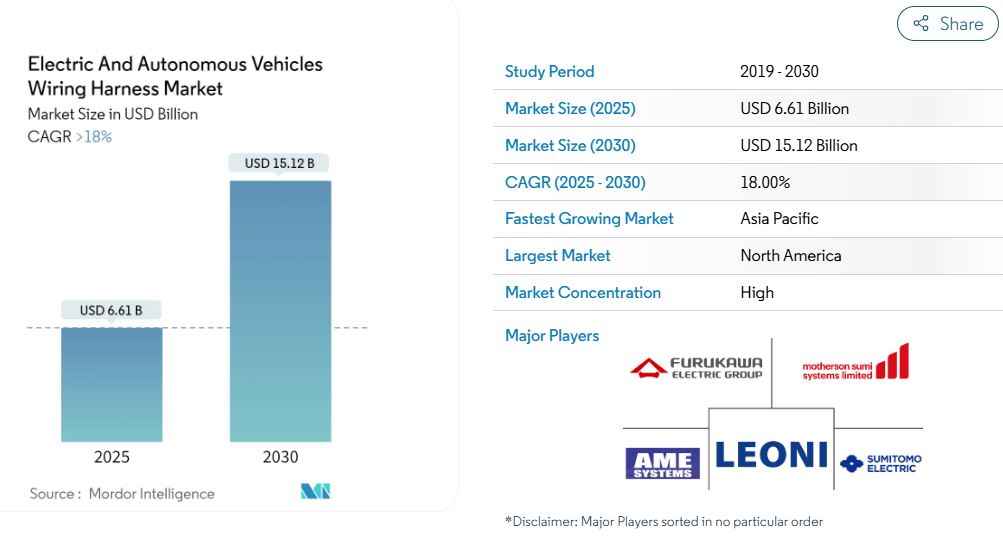
Mordor Intelligenceによると、電気・自動運転車向けワイヤハーネス市場は2025年に約66.1億米ドルと推計され、2030年には約151.2億米ドルへ拡大し、2025~2030年の予測期間で年平均18%超の成長が見込まれています。長期的には各国でEVへの関心が高まり、ディーゼル・ガソリン燃焼に伴うCO2排出削減を目的に政府が自動車メーカーの電動化投資を後押ししていることが市場拡大の基盤です。さらに技術進歩と安全規制の強化により車両搭載の電子部品・システムが増加し、配線・接続を担うワイヤハーネス需要が押し上げられています。先進国では運転の利便性・安全性に対する嗜好が強く、ナビやインフォテインメントが標準装備化した結果、各システムと中央電子制御ユニットをつなぐハーネスの重要性が高まっています。また車両安全への要求と規制強化を背景にADAS市場が成長し、x-by-wire、ブラインドスポット検知、衝突回避、アダプティブクルーズコントロールなどの新技術導入が電子装備を増やし、結果としてEV・自動運転車向けハーネス市場の拡大要因になると整理されています。
トレンドとしては、乗用車セグメントが最も高い成長率になる見通しです。世界のEV販売は2022年に約1,000万台と2021年から大きく増加しており、乗用車だけでなく小型商用車やライトトラックなど幅広い区分を含みます。内燃機関車から小型乗用EVへの移行を加速させる動きが世界的に強まり、燃料価格の上昇はEV普及を後押しする要因として言及されています。BEV・PHEVの販売増も需要拡大の重要因で、各メーカーが継続的にEV需要を喚起しているとされます。中国ではWuling HongGuang、Tesla、BYDなどを中心にBEVが伸び、政府のインセンティブが販売を支えています。インドでも製造・普及促進、排出削減、都市化を背景としたeモビリティ推進の施策が進み、二輪市場の大きさを踏まえて新興メーカーの参入が相次ぐなど、需要拡大が見込まれます。
地域別では北米が先行市場と位置づけられ、公的・民間の施策によりEVへの転換が進み、販売増と消費者認知向上につながっているとされています。米国は欧州に比べ大型商用・公共交通の電動化では遅れがある一方、Teslaの影響もあり電動化が進展し、排出削減政策の強化や大都市の大気汚染問題への対応が背景にあります。FordやGMなど主要OEMのEVラインアップ拡充も需要を刺激し、GMの大規模投資計画が例示されています。加えて、全米での充電インフラ整備(高速道路網を中心とする充電計画の承認など)も普及を後押しする要素です。競争環境ではLeoni、古河電工、Motherson Sumi、矢崎総業、Learなどが主要企業として挙げられ、世界的なEV部品生産能力の拡大が市場成長を支える見通しです。事例としてLeoniはメキシコ工場の生産エリア拡大や高電圧・充電ケーブル関連の投資を進め、ドイツでは従来の集中型ハーネスに代わる小型・分散接続型の配線システム開発に注力する方針が示されています。 |
Electric And Autonomous Vehicles Wiring Harness Market Analysis by Mordor Intelligence
The Electric And Autonomous Vehicles Wiring Harness Market size is estimated at USD 6.61 billion in 2025, and is expected to reach USD 15.12 billion by 2030, at a CAGR of greater than 18% during the forecast period (2025-2030).
Over the long term, the interest and preferences toward electric vehicles increased significantly in various countries across the globe. Moreover, globally, the government encourages automobile manufacturers to invest and develop electric vehicles to reduce carbon emissions caused by diesel and gasoline fuel combustion. Such factors enhance the growth of the wiring harness used in electric and autonomous vehicles.
Technology advancement and increasing safety norms are increasing the components and electronics in the vehicle, which is also boosting the requirement of the wiring harness. Technological advancements and innovations in systems primarily drive the market.
In developed nations, the rising consumer preference toward driving convenience and safety is driving the market’s growth. The adoption of navigation and infotainment systems, among others, became standard features in most cars across the world. To connect these systems and the central electronic control unit, automotive wiring harnesses are required.
The rising demand for vehicle safety and stringent government rules drive the ADAS market growth. Introducing new technologies in vehicles, such as x-by-wire systems, blind spot detection, collision avoidance systems, adaptive cruise control, etc., are increasing the usage of electronic equipment and systems. The use of more electronic equipment is expected to drive the wiring harness market in electric and autonomous vehicles.
Global Electric And Autonomous Vehicles Wiring Harness Market Trends and Insights
Passenger Car Segment is Anticipated to Register Highest Growth Rate
Global EV sales were marked at 10 million units during 2022, which was significantly higher compared to sales figures in 2021. The volume includes all segments, like passenger vehicles, light commercial vehicles, light trucks, and all propulsion types.
The movement to accelerate the adoption of light-duty passenger electric cars (EVs) and phase out traditional vehicles with internal combustion engines is gaining traction around the world. The increase in average fuel prices reflects the fact that Europe holds a higher share of new electric car registrations than other parts of the world. Hence, mass adoption of electric vehicles, owing to rising fuel prices, is expected to increase the business globally.
The market studied is furthermore driven by the increasing sales of BEVs and PHEVs globally, which also remained a major cause for bolstering electric vehicle demand. Manufacturers around the globe consistently drove the demand for EVs.
China also witnessed a steady rise in the BEV segment driven by top Chinese manufacturers, including Wuling HongGuang, Tesla, BYD, Nissan, Toyota, and Honda. The Chinese government constantly provided regulated incentive programs to elevate EV sales.
The government of India undertook multiple initiatives to promote the manufacturing and adoption of electric vehicles in India, reduce emissions from international conventions, and develop e-mobility in the wake of rapid urbanization.
Electric vehicles became a hot topic these days as automakers are announcing their ambitious electrification plans. The sales of electric vehicles are attributed to shifting customer preference toward energy-sustainable mobility, improving charging infrastructure, rising fuel prices, and decreasing fuel prices.
India is the second-largest two-wheeler market, which subsequentially channelizes the demand for the two-wheeler segment in the country. In context to this, many tier-2 manufacturers, for instance, Okinawa Motors, UltraViolette Automotive, and Revolt Motors entered the market to take the early mover’s advantage.
With the development mentioned above across the globe, the demand for electric vehicles is likely to enhance during the forecast period.
North America is Leading the Market
The growing initiatives taken by both the public and private sectors to encourage people to switch to electric vehicles can be attributed to market growth. These initiatives boosted the sales of electric vehicles while also raising consumer awareness of the benefits of owning one.
The United States, although a tad behind in the electrification of heavy-duty commercial and public transport vehicles as compared to Europe, witnessed a significant increase in electrification as a direct influence of Tesla’s electric cars.
In view of the same, the United States is implementing aggressive emission reduction policies and regional initiatives to reduce atmospheric CO2 concentrations. Many major cities, including New York City, Los Angeles, and Houston, are plagued by poor air quality. It resulted in respiratory diseases. Such conditions make survival in the current environment difficult.
Further, key electric vehicle Original Equipment Manufacturers (OEMs), such as Ford and General Motors, offer a diverse range of electric vehicles that piqued the interest of many consumers. It resulted in an expanded market for electric vehicles. For instance,
General Motors announced plans in June 2021 to invest USD 35 billion in developing and increasing its EV production capacity to more than one million by 2025. Furthermore, General Motors announced in January 2022 that it planned to invest approximately USD 6.6 billion in its home state of Michigan by 2024 to increase electric pickup truck production and build a new EV battery cell plant.
Further, regional bodies are taking severe initiatives like approving charging stations to ramp up electric vehicle adoption across the country. For instance, in September 2022, the US Transportation Department announced the approval of electric vehicle charging station plans for all 50 states, Washington, DC, and Puerto Rico, covering roughly 75,000 miles of highways.
The movement to accelerate the adoption of light-duty passenger electric cars (EVs) and phase out traditional vehicles with internal combustion engines is gaining traction around the world. The increase in average fuel prices reflects the fact that Europe holds a higher share of new electric car registrations than other parts of the world. Hence, mass adoption of electric vehicles, owing to rising fuel prices, is expected to increase business globally.
The market studied is further driven by the increasing sales of BEVs and PHEVs globally, which also remained a major cause for bolstering electric vehicle demand. Manufacturers around the world consistently drove the demand for EVs. For instance:
In January 2023, the all-new Volvo EX90 was unveiled in North America for the first time at the Consumer Electronics Show (CES) in Las Vegas. It highlighted the technological collaborations that make the Volvo EX90 the company’s smartest and safest vehicle yet. The Volvo EX90 is an all-electric SUV with seating for up to seven passengers.
With the development mentioned above across the region, the market is anticipated to boost during the forecast period.
Competitive Landscape
Several key players, such as Leoni AG, Furukawa Electric, Motherson Sumi, Yazaki Corporation, Lear Corporation, and others, dominate the electric and autonomous vehicle wiring harness market. The rapid expansion of electric vehicle component manufacturing facilities across the globe is likely to witness major growth for the market during the forecast period. For instance,
In January 2023, to meet the demand for charging cables and high voltage cables for Electromobility applications, Leoni announced that it had increased its production area at its plant in Cuauhtémoc, Chihuahua, Mexico by 40% to 10,723 sq m. The USD 27 million Phase I of the EMOMEX (E-Mobility Mexico) project, which included the installation of machinery and equipment for the development and production of high-voltage cables and charging system cables, was completed.
In September 2022, the expansion of Leoni AG’s (Leoni) product developments was announced. A new wiring system will be developed by the company, gathering engineers at the Innovation Industrialization Center (IIC) in Kitzingen, Germany. The company intends to boost its development to expand autonomous mobility and meet the rising demand for wiring systems. In place of the usual central cable harness, the company will concentrate on smaller-scale connected wiring harnesses.
1. INTRODUCTION
1.1 Study Assumptions
1.2 Scope of the Study
2. RESEARCH METHODOLOGY
3. EXECUTIVE SUMMARY
4. MARKET DYNAMICS
4.1 Market Drivers
4.1.1 Rise in Electric Vehicle Sale
4.2 Market Restraints
4.2.1 High Maintenance Cost
4.3 Industry Attractiveness – Porter’s Five Forces Analysis
4.3.1 Bargaining Power of Suppliers
4.3.2 Bargaining Power of Buyers/Consumers
4.3.3 Threat of New Entrants
4.3.4 Threat of Substitute Products
4.3.5 Intensity of Competitive Rivalry
5. MARKET SEGMENTATION (Market Size in Value (USD))
5.1 By Vehicle Type
5.1.1 Passenger Cars
5.1.2 Commercial Vehicles
5.2 By Application
5.2.1 Powertrain
5.2.2 Comfort And Convenience
5.2.3 Safety And Security
5.2.4 Body Wiring
5.2.5 Others
5.3 By Components
5.3.1 Wires
5.3.2 Terminals
5.3.3 Relays
5.3.4 Fuses
5.3.5 Connectors
5.3.6 Others
5.4 By Geography
5.4.1 North America
5.4.1.1 United States
5.4.1.2 Canada
5.4.1.3 Rest of North America
5.4.2 Europe
5.4.2.1 Germany
5.4.2.2 United Kingdom
5.4.2.3 France
5.4.2.4 Italy
5.4.2.5 Spain
5.4.2.6 Rest Of Europe
5.4.3 Asia-Pacific
5.4.3.1 China
5.4.3.2 India
5.4.3.3 Japan
5.4.3.4 South Korea
5.4.3.5 Rest of Asia-Pacific
5.4.4 Rest of the World
5.4.4.1 South America
5.4.4.2 Middle-East and Africa
6. COMPETITIVE LANDSCAPE
6.1 Vendor Market Share
6.2 Company Profiles*
6.2.1 Furukawa Electric Group
6.2.2 Leoni AG
6.2.3 Motherson Sumi Systems Limited
6.2.4 Sumitomo Electric Wiring Systems Inc.
6.2.5 AME Systems (VIC) Pty Limited
6.2.6 Electronic Technologies International Inc.
6.2.7 Aptiv PLC
6.2.8 Yazaki Corporation
6.2.9 Patrick Industries Inc.
6.2.10 Lear Corporation
6.2.11 TE Connectivity Ltd.
6.2.12 Elcom Inc.
7. MARKET OPPORTUNITIES AND FUTURE TRENDS


